A history resource article by Mary Harrsch © 2015
I noticed that a program entitled "Alexander the Great's Mysterious Death" on the Discovery Channel put forward the hypothesis that Alexander died from an accidental overdose of hellebore, a poisonous plant used to induced vomiting in ancient times.
[Alexander the Great, Photographed at the Capitoline Museum, Rome, Italy by Mary Harrsch © 2005 ]
Back in 1998, however, a group of doctors gathered for a clinical pathology conference at the University of Maryland Medical Center expressed their belief that Alexander was killed by an intestinal bug:
Update: 2/18/2015:
In January 2014 an article was published in the Journal of Clinical Toxicology. Co-authored by the University of Otago 's Dr. Leo J. Schep, from the National Poisons Centre in New Zealand, the researchers theorized that Alexander was killed by a toxic wine created using a fermented form of Veratrum album (also known as white hellebore) sometimes used to induce vomiting. The study's authors detailed the potential deadliness of the plant in the study abstract:
Veratrum poisoning is heralded by the sudden onset of epigastric and substernal pain, which may also be accompanied by nausea and vomiting, followed by bradycardia and hypotension with severe muscular weakness.
"Exposure to extracts from this plant causes clinical effects similar to [Alexander's] reported signs and symptoms," Schep observes, "Of note was the duration of symptoms, which could continue for more than 12 days if intoxicated patients are not treated."
Personally, I think the analysis by the pathologists in Maryland appears more credible (to me) since they evaluated the overall reported symptoms as detailed in fragments of the ancient sources rather than focus on the relatively immediate reactions Alexander experienced at a banquet with his generals that has long been viewed historically as suspect. If Alexander's digestive tract was already severely compromised (by a pathogen like typhoid), his consumption of normal wine at the banquet could have triggered an acute episode of abdominal distress. Without his remains, however, I guess we will never know!
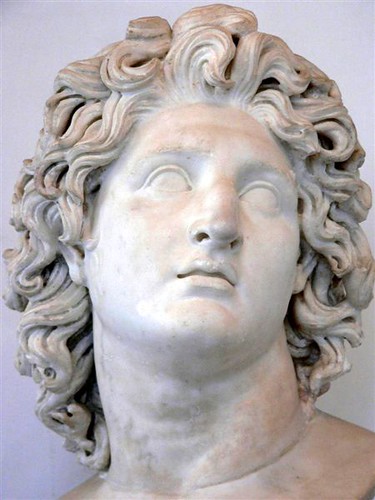 |
| Head of Alexander the Great photographed at The Capitoline Museum in Rome, Italy by Mary Harrsch © 2005. |
I noticed that a program entitled "Alexander the Great's Mysterious Death" on the Discovery Channel put forward the hypothesis that Alexander died from an accidental overdose of hellebore, a poisonous plant used to induced vomiting in ancient times.
[Alexander the Great, Photographed at the Capitoline Museum, Rome, Italy by Mary Harrsch © 2005 ]
Back in 1998, however, a group of doctors gathered for a clinical pathology conference at the University of Maryland Medical Center expressed their belief that Alexander was killed by an intestinal bug:
Alexander the Great, who ruled much of the ancient world until his death in 323 B.C., was conquered at age 32 not by an enemy, but possibly by a tiny intestinal bug. In an analysis based on available historical records, physicians at the University of Maryland Medical Center believe that Alexander was the victim of typhoid fever.
Their analysis, titled, "A Mysterious Death," is published in the June 11 issue of the New England Journal of Medicine. The most popular theories among historians previously have been that Alexander was poisoned or had died of malaria.
In the week before he died, historical accounts say Alexander the Great had chills, sweats, exhaustion and high fever, all of which are typical symptoms of certain infectious diseases, including typhoid fever.
"He was also described as having severe abdominal pain, causing him to cry out in agony," says David W. Oldach, an infectious disease expert at the University of Maryland Medical Center and lead author of the article.
"That was an important clue, because untreated typhoid fever can lead to perforation of the bowel and may have been the reason for his abdominal pain," according to Dr. Oldach, who is also an assistant professor of medicine at the University of Maryland School of Medicine.
"My discussions with Dr. Oldach and his colleagues caused me to change my mind about what caused the death of Alexander the Great," says Eugene N. Borza. Ph.D., professor emeritus of ancient history who taught for 31 years at Penn State University. Dr. Borza, who is also an author of the New England Journal article, previously thought that malaria caused Alexander's demise.
A curious symptom described in ancient accounts is that Alexander's body did not begin to decay for at least several days after his death. Dr. Oldach says while that defies reason, those around him may have gotten that impression because of another complication of typhoid fever, called ascending paralysis. It is a neurological problem that starts with the feet and moves up the body, paralyzing muscles and slowing down breathing. It can make a person look dead, even if he is not. Alexander may have been in that state for a few days before he died.
 |
| The death of Alexander the Great. Courtesy of History.com. |
Accounts of the death were not consistent with poisoning, although Dr. Borza says that has been a popular belief. "It was an ancient conspiracy theory. People have often suspected a conspiracy when a famous young person dies unexpectedly." Dr. Borza says ancient Greeks who didn't succumb to disease as a child or a battlefield wound often lived into their 70's, because of a healthy diet and constant physical activity.
The New England Journal of Medicine article is believed to be the first collaboration between medical scientists and an historian to answer an ancient question about what caused a famous historical figure to die. Dr. Borza says the earliest surviving accounts about Alexander's death available today were written three centuries after he died, so there was not a lot of information to go on.
"Even so, we found out that much of the scant information we do have is credible, because it makes sense to the medical community. It is important for us to be able to validate the evidence and set the record straight. As historians, that's what we try to do," says Dr. Borza.
For his analysis, Dr. Oldach also had to rely on historical medical accounts of what happens when typhoid fever goes untreated with antibiotics, which did not become available until the 1950's. U.S. physicians today rarely witness untreated patients in the late stages of typhoid fever.
Typhoid fever comes from salmonella typhi, an organism that lives only in humans and can be spread by contaminated water or because of poor hygiene.
Update: 2/18/2015:
In January 2014 an article was published in the Journal of Clinical Toxicology. Co-authored by the University of Otago 's Dr. Leo J. Schep, from the National Poisons Centre in New Zealand, the researchers theorized that Alexander was killed by a toxic wine created using a fermented form of Veratrum album (also known as white hellebore) sometimes used to induce vomiting. The study's authors detailed the potential deadliness of the plant in the study abstract:
 |
| "Veratrum album flower" by Alpsdake. Courtesy of Wikimedia Commons. |
Veratrum poisoning is heralded by the sudden onset of epigastric and substernal pain, which may also be accompanied by nausea and vomiting, followed by bradycardia and hypotension with severe muscular weakness.
"Exposure to extracts from this plant causes clinical effects similar to [Alexander's] reported signs and symptoms," Schep observes, "Of note was the duration of symptoms, which could continue for more than 12 days if intoxicated patients are not treated."
Personally, I think the analysis by the pathologists in Maryland appears more credible (to me) since they evaluated the overall reported symptoms as detailed in fragments of the ancient sources rather than focus on the relatively immediate reactions Alexander experienced at a banquet with his generals that has long been viewed historically as suspect. If Alexander's digestive tract was already severely compromised (by a pathogen like typhoid), his consumption of normal wine at the banquet could have triggered an acute episode of abdominal distress. Without his remains, however, I guess we will never know!
 
|
 
|
 
|


